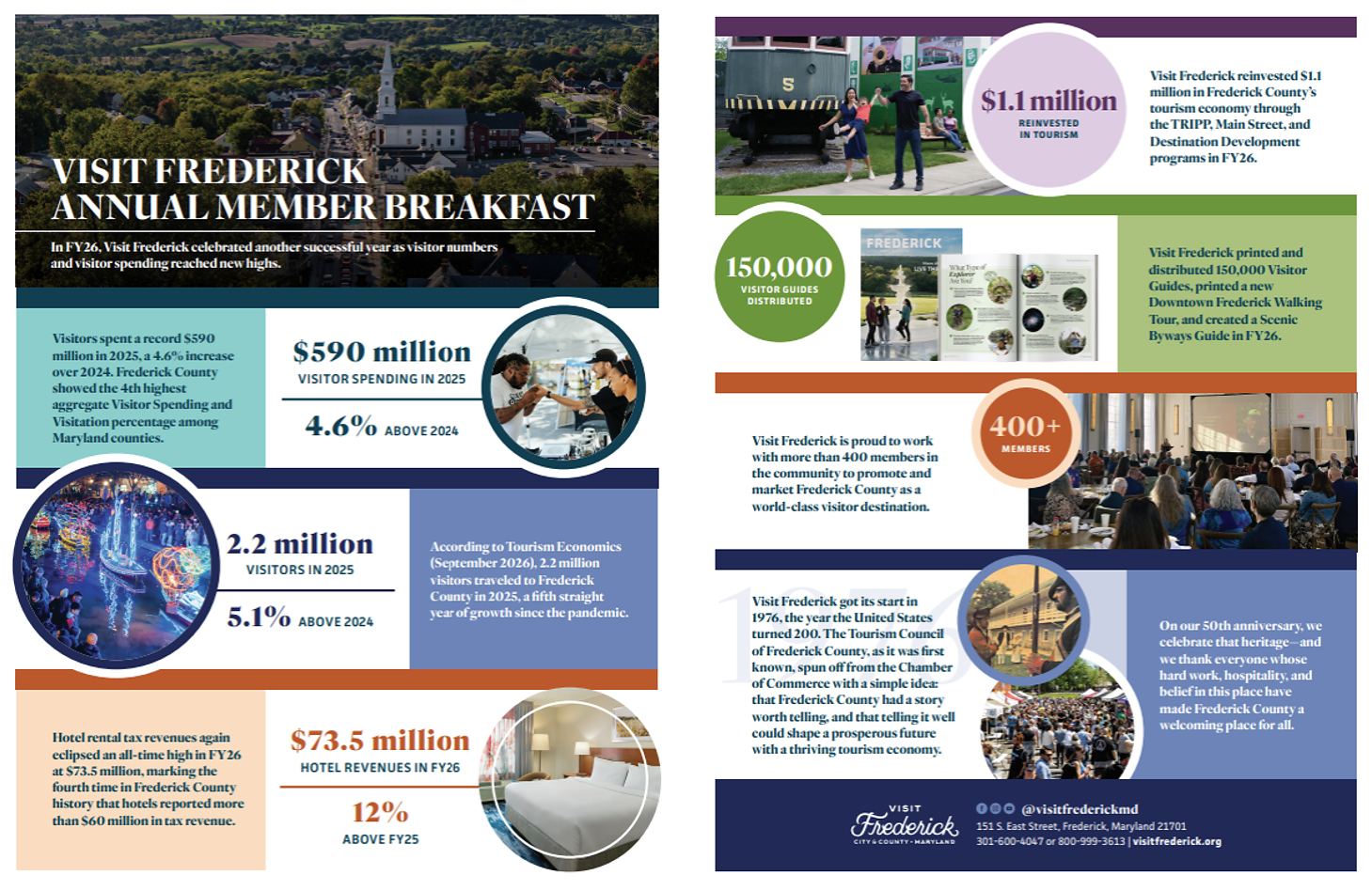
Frederick County, Maryland pulled in a record $590 million in visitor spending in 2025, with restaurants and craft beverage businesses alone capturing $181 million of that total — a figure that underscores how hospitality operators in mid-sized destination markets can punch well above their weight when tourism infrastructure is working.
Visit Frederick, the county's official destination marketing organization, released the numbers at its annual meeting on October 15. Executive Director Dave Ziedelis attributed the results to the network of small businesses, hotels, and Main Street attractions that collectively shape the visitor experience. "Last year, that story brought 2.2 million visitors to our county, and they spent a record $590 million here," Ziedelis said. "Those results belong to our partners — the small businesses, Main Streets, attractions, and hotels that welcome visitors to Frederick County every day."
The Numbers
According to Tourism Economics, the $590 million in visitor spending represents a 4.6% year-over-year increase — even as statewide visitor spending in Maryland dipped 0.05% over the same period. Total visitation reached 2.2 million, up 5.1% from 2024 and ahead of Maryland's statewide growth rate of 3.6%. Of those visitors, 776,500 stayed overnight while 1.4 million made day trips. For food and beverage operators, day-trip traffic in particular represents a captive, high-intent dining audience that arrives ready to spend on local experiences rather than groceries.
Hotel rental tax revenue hit $73.5 million in fiscal year 2026, a 12% jump over the prior year and an all-time high for the second consecutive year. That revenue directly funds Visit Frederick's marketing budget and its grant programs — meaning stronger lodging performance translates into more promotional dollars driving diners and drinkers through local doors. Tourism-generated jobs reached 6,367, accounting for 5.8% of total county employment, with direct tourism employment growing 7.1% against a 1.8% statewide decline.
Why It Matters for Operators
The Frederick data offers a useful case study for restaurant and hospitality operators evaluating how destination marketing investment correlates with on-the-ground revenue. The county's tourism engine has now generated more than $8.7 billion in cumulative visitor spending since its hotel rental tax launched in 2003 — a long track record that validates sustained public-private investment in place-based marketing.
For foodservice businesses specifically, the craft beverage category continues to be a draw. Frederick County has cultivated a notable cluster of breweries, wineries, and distilleries that function as visitor attractions in their own right, pulling guests who then extend their stay into restaurant meals and retail purchases. The $181 million in combined food and beverage spending — versus $85 million on recreation and $71 million at retail — confirms that eating and drinking remains the dominant on-the-ground activity for destination travelers, a pattern consistent with broader hospitality industry trends tracked across leisure markets nationwide.
Visit Frederick also reported that its downtown visitor center activated 4,457 Downtown Frederick gift cards valued at $330,980 in FY26, a direct channel that routes visitor dollars specifically toward participating local businesses. Top feeder markets outside Maryland included Virginia, Pennsylvania, Washington D.C., Florida, and New Jersey — geographies that skew toward drive-market leisure travelers, a segment known for higher per-visit food and beverage spend.
Looking ahead, Visit Frederick's newly adopted 2026–2031 Strategic Plan sets priorities around marketing, product development, and partnership growth — signaling continued institutional support for the hospitality businesses that anchor the visitor experience.
Written by Michael Politz, Author of Guide to Restaurant Success: The Proven Process for Starting Any Restaurant Business From Scratch to Success (ISBN: 978-1-119-66896-1), Founder of Food & Beverage Magazine, the leading online magazine and resource in the industry. Designer of the Bluetooth logo and recognized in Entrepreneur Magazine's "Top 40 Under 40" for founding American Wholesale Floral, Politz is also the Co-founder of the Proof Awards and the CPG Awards and a partner in numerous consumer brands across the food and beverage sector.